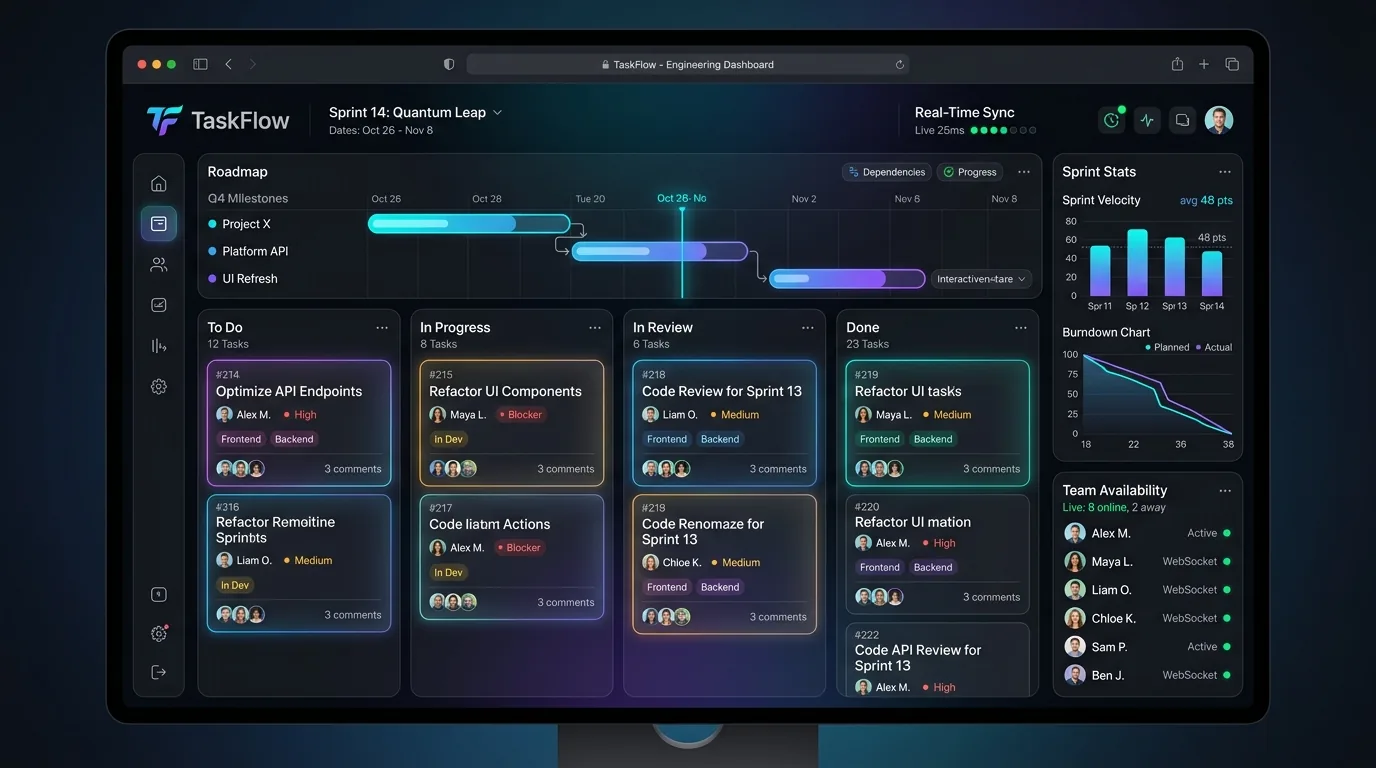
TaskFlow Cloud is an enterprise project management platform designed for agile engineering teams. Their previous monolithic framework suffered from cross-tenant data isolation vulnerabilities, sluggish manual page refreshes to see task updates, and complex subscription billing bugs. codeYB re-architected TaskFlow as a scalable multi-tenant SaaS application featuring PostgreSQL Row-Level Security (RLS), Redis Pub/Sub WebSocket gateways, and automated Stripe billing.
Core Business Imperative
Enterprise corporate clients required strict SOC-2 compliance guarantees that their proprietary task data could never be seen by other tenants. Simultaneously, distributed remote teams demanded sub-second collaborative task board updates without manual browser reloads.
🔍
Existing Technical Problems & Legacy Bottlenecks
Bottleneck #1
Fragile Application-Level Tenant Filtering
A single missing tenantId filter in an ORM query could expose confidential organizational project files to third parties.
Bottleneck #2
HTTP Polling Overloading Database Connections
Thousands of clients polling the server every 5 seconds consumed 80% of database CPU capacity on redundant queries.
Bottleneck #3
Un-indexed Recursive Task Tree Queries
Fetching nested epic-story-task hierarchies required 12 separate database joins, taking 2.4 seconds per page load.
⚠️ Core Engineering & Operational Roadblocks
1. Cross-Tenant Data Exposure Vulnerabilities
Application-level WHERE tenant_id clauses were prone to developer oversight, risking cross-tenant data leaks during rapid feature development.
2. Lack of Real-Time Collaborative Canvas Sync
Team members moving tasks on Kanban boards did not update on teammates' screens without a full browser reload, causing status confusion.
3. Billing Proration & Seat Management Bugs
Legacy billing scripts failed during middle-of-month employee additions and tier upgrades, producing billing reconciliation discrepancies.
💡 Architectural Solutions Engineered by codeYB
✓ PostgreSQL Row-Level Security (RLS) Engine
Enforced tenant data isolation directly at the database engine level, guaranteeing zero possibility of cross-tenant data leaks.
✓ Redis Pub/Sub WebSocket Multiplexing Cluster
Architected a high-concurrency WebSocket gateway that propagates Kanban card drag-and-drops in 15ms to all active workspace viewers.
✓ Stripe Tiered Subscription & Customer Portal
Built automated billing workflows handling seat additions, automated prorated charges, and dunning email recovery flows.
📋
System Requirements & Architectural Specifications
Security & Multi-Tenancy
Kernel-level data isolation utilizing PostgreSQL Row-Level Security (RLS) tied to authenticated session tokens
SAML 2.0 and Google Workspace Single Sign-On (SSO) integration for enterprise authentication
Immutable audit logs tracking all user role adjustments and project export requests
Real-Time Collaboration & Billing
Sub-50ms WebSocket broadcast of Kanban card movements across all connected workspace members
Automated Stripe Billing integration handling seat-based licensing, plan upgrades, and prorated invoices
Self-service customer portal allowing organization admins to manage payment methods and seats
🏗️
Multi-Tenant Cloud SaaS Infrastructure Topology
TaskFlow utilizes a multi-tenant PostgreSQL database where every query is authenticated against a signed JWT containing the tenant_id claim, enforced by PostgreSQL RLS. Real-time events are published to a Redis Pub/Sub cluster and broadcasted to clients over persistent WebSockets.
🏢 Data SupplierIndependent Security Auditing Firm & codeYB Database Specialists
Database CPU Consumption Under Load
🔍 AWS RDS PostgreSQL Performance Insights
Legacy Baseline84% (Heavy Polling)
codeYB Production18% (WebSocket Push)
78% CPU Overhead Reduction
⏱️ Baseline PeriodQ1 2024 weekly active team member engagement (48.5%)
📈 Comparison WindowQ2 2024 weekly active team member engagement (84.2%)
🔍 Telemetry SourceSegment product analytics & Amplitude user retention telemetry
🔄 Architectural ChangeInstant drag-and-drop ticket movement, live collaborator cursors, and instant notifications
🏢 Data SupplierAlex Rivera, Head of Engineering, TaskFlow Cloud
📐Empirical Evidence & Measurement Methodology
Every performance improvement, latency drop, and conversion lift reported by codeYB is audited against pre-release baselines using real user monitoring (RUM), APM distributed tracing, and verified client operational telemetry.
Seasonality Control✓ Controlled: Benchmarked during sprint planning sessions with 150 concurrent team editors per workspace
Every table contains a tenant_id column. Policies enforce: CREATE POLICY tenant_isolation_policy ON tasks USING (tenant_id = current_setting('app.current_tenant_id')::uuid).
PostgreSQL 16 RLS with session-scoped configuration parameters
Redis Pub/Sub Channel Sharding
WebSocket events are partitioned by workspace ID (e.g., workspace:uuid:events), preventing noisy-neighbor broadcasts across unrelated client sockets.
Redis Cluster 7.2 with pub/sub channel partitioning and backpressure buffers
“
Architecture & Technical Review Note
"codeYB architected TaskFlow to enterprise standards from Day 1. The PostgreSQL RLS security model passed our corporate security audit with flying colors, and the real-time collaboration is blazing fast."
Tenant isolation enforced at the database engine level using tenant_id session claims; impossible for one tenant to query another tenant rows.
Scoped RBAC & Fine-Grained Permissions
Workspace roles (Owner, Admin, Member, Guest) mapped to cryptographic JWT permissions validated at API boundary.
Audit Trail Logging
Every ticket edit, board move, and user privilege escalation recorded to an immutable append-only audit log.
💡
Lessons Learned & Senior Architectural Takeaways
1. Enforce Multi-Tenancy at the Database, Not the ORM
Relying on developers to remember where: { tenantId } in every ORM query creates inevitable vulnerabilities. PostgreSQL RLS made security architectural and un-bypassable.
We use PostgreSQL Row-Level Security (RLS). The database engine itself rejects any query attempting to read rows with a different tenant_id, even if application code had a bug.
🔗
Related codeYB Services & Engineering Capabilities