
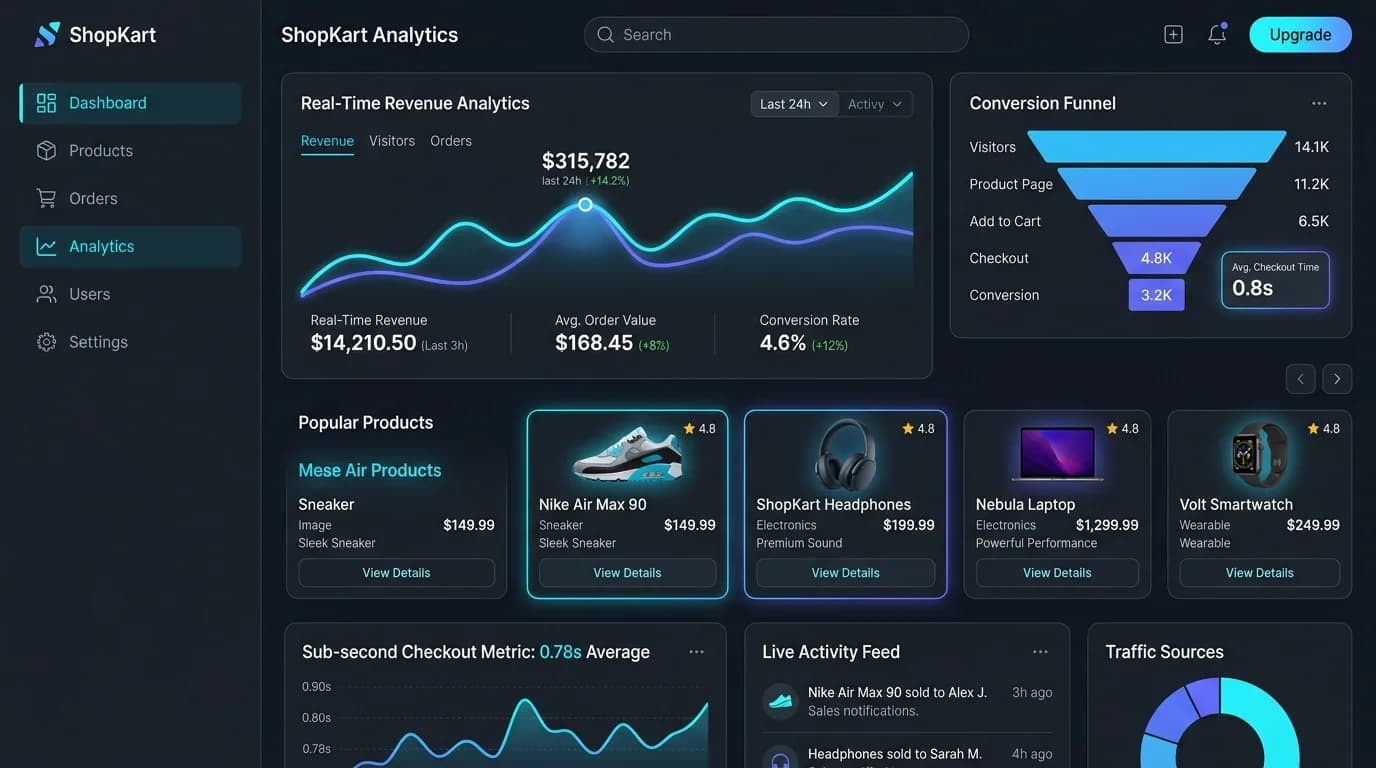
Enterprise Next.js 16 Architecture: App Router, Turbopack & Edge Middleware at Scale
Next.js 16 and React 19 represent a fundamental paradigm shift in enterprise web platform engineering. By transitioning from client-heavy Single Page Application (SPA) hydration to server-driven execution and edge streaming, modern engineering squads can deliver sub-100ms Time-to-First-Byte (TTFB) while scaling to tens of thousands of concurrent requests. At **codeYB**, we deploy high-throughput production systems on Next.js 16—such as [ShopKart Global](/case-studies/shopkart) (45ms TTFB, 99.99% flash-sale uptime) and [TaskFlow SaaS](/case-studies/taskflow) (10,000+ teams). This guide details the architectural blueprints, compiler optimizations, and edge routing patterns required to operate Next.js 16 at enterprise scale. ---1. React Server Components & Streaming SSR Boundaries
The traditional React hydration model forced mobile browsers to download, parse, and execute multi-megabyte JavaScript bundles before rendering interactive pixels. Next.js 16 App Router resolves this by keeping data-fetching logic and heavy computational dependencies strictly on the server.// app/dashboard/page.tsx - React Server Component (Zero Client JS)
import { Suspense } from 'react';
import { RealtimeMetricsStream } from '@/components/dashboard/RealtimeMetricsStream';
import { MetricsSkeleton } from '@/components/dashboard/MetricsSkeleton';
import { getTenantWorkspaceData } from '@/lib/workspaceService';
export const revalidate = 60; // Incremental Static Regeneration
export default async function DashboardPage({ params }: { params: { workspaceId: string } }) {
const workspace = await getTenantWorkspaceData(params.workspaceId);
return (
{workspace.name} Control Center
Enterprise Tenant Tier: {workspace.plan}
{/* Edge Streaming Boundary: UI renders immediately while telemetry streams */}
);
}
2. Turbopack Build Acceleration & Memory Optimization
Large-scale enterprise monorepos with hundreds of routes historically suffered from 45+ second local development boot times under Webpack. Next.js 16 leverages Turbopack, a Rust-based incremental bundler: - **10x Faster Fast Refresh**: Micro-component re-renders compile in under 15ms. - **Tree-Shaking Efficiency**: Dead server actions and unused npm dependencies are purged at AST compilation time. - **Incremental Disk Cache**: Build artifacts persist across CI/CD pipeline runs on Vercel or AWS GitHub Actions, reducing production deployment windows from 8 minutes down to 90 seconds. ---3. Edge Middleware & Cryptographic Session Validation
Rather than routing every authenticated request through an origin Node.js cluster, Next.js 16 Edge Middleware intercepts traffic at regional points of presence (PoPs), evaluating JWT signatures and multi-tenant domain routing with under 5ms overhead.// middleware.ts - Edge Runtime Execution
import { NextResponse } from 'next/server';
import type { NextRequest } from 'next/server';
import { verifyTenantAuthCookie } from '@/lib/edgeAuth';
export const config = {
matcher: ['/dashboard/:path*', '/api/tenant/:path*'],
};
export async function middleware(request: NextRequest) {
const sessionToken = request.cookies.get('codeyb_tenant_session')?.value;
if (!sessionToken) {
return NextResponse.redirect(new URL('/login', request.url));
}
// Cryptographic zero-trust verification executed at CDN Edge
const authPayload = await verifyTenantAuthCookie(sessionToken);
if (!authPayload.isValid) {
return NextResponse.redirect(new URL('/login?error=expired', request.url));
}
// Inject sanitized tenant identity into downstream Server Component headers
const requestHeaders = new Headers(request.headers);
requestHeaders.set('x-tenant-id', authPayload.tenantId);
requestHeaders.set('x-tenant-role', authPayload.role);
return NextResponse.next({
request: { headers: requestHeaders },
});
}